The Narrator and His Birth Parents
The Painted BirdThe narrator’s reunion with his birth parents resolves the question of where he belongs without resolving what belonging means to him. A birthmark confirms their relationship, and they take him from the orphanage, but he experiences their love as both care and confinement. Their reunion is therefore not a simple return to safety: it forces a boy who has survived by imagining his own future to confront the claims of family, dependence, and choice.
Recognition and Reunion
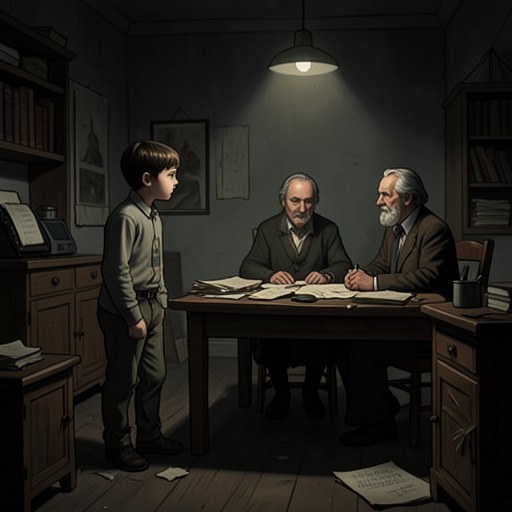
The meeting takes place in the principal’s office, where the principal is accompanied by a member of the Social Commission who believes he knew the narrator’s parents before the war. The adults are nervous, though they try to hide it, and the narrator hears voices in an adjoining office before the Commission member opens the door. A man and woman stand there. Their faces seem familiar, and their resemblance to the parents he might have had is striking. Beneath the star on his uniform, his heart beats hard as he tries to decide whether to admit recognition or pretend not to recognize them.
The woman bends over him with tears on her face; the man, adjusting spectacles on his damp nose, supports her and struggles to contain his own sobs. He speaks Russian fluently, in a way the narrator compares to Gavrila’s speech, and asks him to unbutton his uniform. A birthmark should be on the left side of his chest. The narrator knows it is there and hesitates, understanding that showing it will remove any doubt that he is their son. He finally opens his uniform, and the birthmark confirms the relationship. His parents embrace and kiss him, transforming what had been a possibility into an established fact.
The Claims of Family and Freedom
Confirmation does not bring immediate emotional acceptance. The narrator considers what the discovery will mean: as Gavrila had often told him, parents have a right to their children, and at twelve he is not yet grown. Even if they did not want to take him, he thinks, it would be their duty to do so. He looks again at the woman who is his mother and the man who is his father. They seem frail and ill rather than like people who would beat him, but their gentleness does not make the obligations of kinship easy for him to accept.
He knows he could still escape. He could board one of the crowded trains and travel until no one could trace him. Yet he wants Gavrila to find him, and decides that running away would be unwise. This hesitation is bound up with the future he has imagined: reunion means giving up dreams of becoming a great inventor of fuses that change people’s color and of living in the land of Gavrila and Mitka, where tomorrow already seemed to have arrived. The prospect of a real family competes with a chosen world of teachers, political hopes, and self-invention.
The narrator cannot readily accept being someone’s son in the full sense of the word: being caressed and cared for, and having to obey not because someone is stronger or can hurt him, but because parents possess a claim over their child. He believes a boy his age should be free to choose whom to follow and learn from. At the same time, he cannot bring himself to leave. Looking at his tearful mother and trembling father, uncertain whether to stroke his hair or pat his shoulder, he feels an inward force holding him back. He understands the pull through the image of Lekh’s painted bird, drawn toward its own kind by an unknown force. Kinship attracts him even as he resists the restrictions he associates with it.
Promises and the Household He Enters
Left alone with him, his mother promises that he will be happy with her and his father and can do whatever he wants. They will even have a new uniform made as an exact copy of the one he is wearing. Her offer tries to bridge his existing identity and the life waiting for him at home: rather than asking him to relinquish the uniform that marks his wartime self, she promises its continuation. Still, her reassurance does not immediately settle his doubts.
The image that comes to his mind is Makar’s trapped hare. Once released from its cage, the animal sits in the meadow, apparently attending to a freedom that belongs wholly to it. But it does not run away. It turns back, grows sluggish, and returns to the hutch; after that, the cage is within it, binding its mind and heart and paralyzing its muscles. The memory gives the narrator a way to understand how a person might become attached to confinement even after escape is possible. It also complicates his own decision: staying with his parents may be a form of return, but it may also mean carrying restrictions inside himself.
His father returns after handling the formalities. Before leaving, the narrator and his parents go to say goodbye to the Silent One. The Silent One regards the parents suspiciously, shakes his head, and refuses to greet them. The response sets the narrator’s new family against the relationships formed during his earlier life without explaining away either attachment. Outside, his father carries some of his books, while ragged, haggard people with sacks crowd the streets, returning to homes and quarrelling with those who occupied them during the war. The narrator walks between his parents, feeling their hands on his shoulders and hair, but describes their affection as smothering. Their care is real; so is his discomfort with being surrounded by it.
After the Reunion
The family’s reunion leads not to a spacious or settled home but to a cramped apartment they have borrowed with difficulty after learning that a boy matching their son’s description was at the local center. The apartment has one room and a kitchen, with a washroom on the stairs. The narrator’s father has a heart condition and becomes pale and perspiring when upset, then swallows pills; his mother rises at dawn to queue for food and returns to cook and clean. Such circumstances make parental care concrete and laborious, rather than an abstract promise of protection.
The parents also have a four-year-old adopted son, an orphan whose parents and older sister were killed. His old nurse saved him and handed him to the narrator’s father during the family’s wanderings in the third year of the war. The parents love the child, and the narrator sees that affection. Rather than reassuring him, the discovery deepens his uncertainty: he wonders whether it would be better to remain alone and wait for Gavrila to adopt him. He would prefer wandering from village to village and town to town, never knowing what might happen, to the predictability of this crowded household.
That tension soon enters the children’s daily life. The younger boy interrupts the narrator while he reads newspaper reports of Red Army successes, clutches his trousers, and knocks over his books. The narrator grabs and squeezes the boy’s arm until it breaks. His father calls a doctor; later, with the child’s arm in a cast, the boy whimpers and looks at the narrator in terror, while the parents look at him without a word. The scene does not erase the parents’ earlier tenderness, but it shows the fragile and difficult family life into which the reunion has brought him. His return establishes who his parents are and where he will live; it does not instantly make him feel at home among them.